 BeachFinder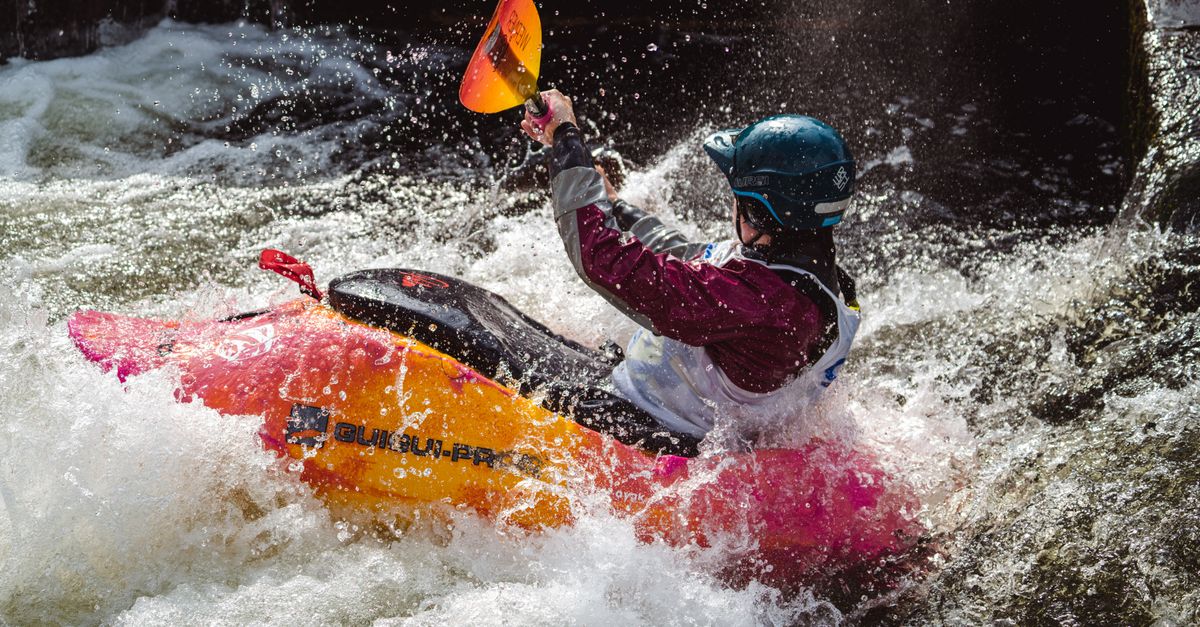
The basic safety kit
Nothing goes on the water without the full kit. It's designed to absorb impacts, keep you afloat in a capsize and let you help others.
- Helmet — protects against rocks, essential from Class II and strongly advised everywhere.
- Personal flotation device (PFD) — a whitewater-specific model, well fitted and fastened, with enough buoyancy.
- Spraydeck (spray skirt) — seals the cockpit; its release loop must stay within reach so you can get out fast.
- Throw bag — to throw a line to a swimmer from the bank or an eddy.
- Whistle — to alert the group (a sound signal carries further than the voice over the noise of the water).
- Wetsuit or insulating layer — neoprene or a drysuit depending on the season, against the cold.
Never alone, always within your level
You never paddle whitewater alone: a buddy or a group can step in for a capsize, a swim or an entrapment. Going solo removes any backup if something goes wrong and turns a minor incident into a serious situation.
Pick a river whose class matches what you genuinely have under control, not what you hope to pull off. Dropping one class below your maximum when discovering a river is a sound principle. Progress in stages, consolidating each level, ideally with a club or an instructor at first: training speeds up your independence and locks in the right reflexes.
Scouting the rapids and reading the water
Before a rapid you don't know, stop in an eddy and go scout it from the bank. You identify the line, the stoppers, the rocks and above all the obstacles to avoid, then set a plan (and a plan B in case of a capsize).
Reading the water is learned gradually. A few useful markers:
- Tongue (main flow) — the smooth downstream V, often the clean passage.
- Eddy — calm water behind an obstacle, to stop and regroup.
- Stopper (hole) — the water surging back up below a lip; a wide, uniform stopper can hold you.
- Siphon (sieve) — the water disappears under or between rocks; a lethal hazard, to be avoided at all costs.
If in doubt about a passage, portage on foot: backing off is part of the skill set. BeachFinder lists whitewater spots and, where the data exists, shows condition benchmarks to help you prepare the outing.
Cold water and strainers: the underrated dangers
Two hazards kill more than the rapids themselves. First, cold water: even in summer, snowmelt or spring water causes a thermal shock that takes your breath away, speeds up exhaustion and quickly saps your hand mobility after a capsize. A neoprene wetsuit (or a drysuit in spring) is often essential to stay functional.
Then strainers (fallen trees, branches, grates): they let the water through but pin a body against the obstacle, with no way back up. You never go near them. Watch out too for the foot-entrapment trap: never put your foot down on the bottom in a strong current, as it can jam between two rocks and the current tips your head underwater.
The skills that save lives
Beyond gear, a few skills to work on before the serious rapids, ideally in a pool or on easy water first:
- The roll — righting yourself without leaving the kayak; it's the skill that avoids swimming and most risky situations.
- The wet exit — release the spraydeck and calmly get out of the upside-down kayak when the roll fails.
- Whitewater swimming — on your back, feet downstream and up, to protect yourself, then active swimming towards the bank once the current eases.
- Throwing and catching a rope — knowing how to throw a throw bag and, as a swimmer, catch it and let yourself swing towards the bank without wrapping the rope around your body.
Handling a capsize and helping others
A capsize (rolling over and coming out of the kayak) is a normal incident, not a disaster, if handled methodically. The absolute priority is the person, then the gear:
- The swimmer — stays calm, gets on their back feet downstream, holds their paddle, and reaches the eddy or the rope thrown to them. You recover the kayak and paddle afterwards.
- The group — a teammate offers their boat (swimmer recovery) or throws a rope from a safe spot; the others watch downstream and flag the dangers.
- Signals — agree before the descent on simple signs (paddle held vertical = stop, motion to one side = go that way).
A whitewater safety course (self-rescue and rescuing others) is the best investment for paddling with peace of mind.