 BeachFinder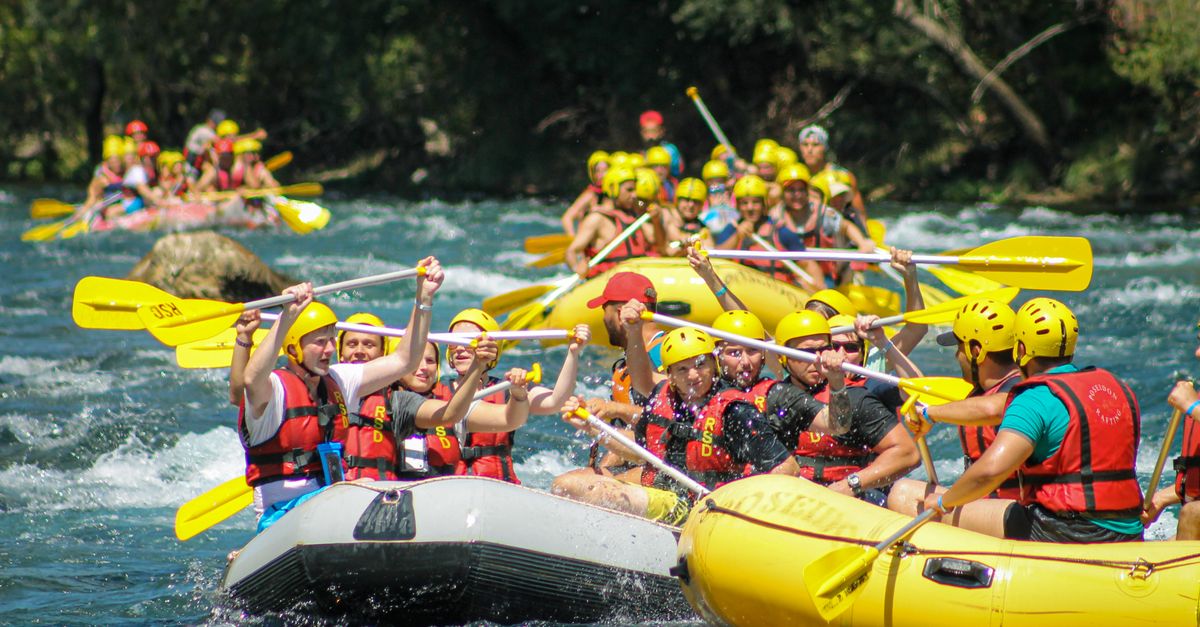
Always start with a guide
Beginner rafting is done as a guided descent led by a qualified instructor, never alone. The guide steers the raft from the back, gives the paddling instructions, picks the line through the rapids and manages the group's safety. No experience or exceptional fitness is required for a first descent on a suitable section.
What's expected of you is simple: to be able to swim a little, to be comfortable with the idea of falling in, and above all to listen and carry out the instructions quickly. A raft moves and turns because the whole crew paddles together at the right moment; it's this coordination, more than strength, that gets you through the rapids.
Aim for a Class II-III river
Class II-III is the ideal terrain to get started: enough rapids for fun and thrills, but sections that stay manageable in a guided group. Class I is too calm to really feel the rafting, while Class IV and above already calls for experience, commitment and the ability to handle a swim in a powerful current.
Outfitters almost always offer a "discovery" run tailored to first-timers, often family-friendly. The same stretch can rise in intensity depending on the flow: at low summer water it's gentle, while in higher water in spring it becomes more physical. Always ask what class the trip corresponds to on the day itself.
The gear: what's provided
Operators supply the safety equipment and the raft. On your side, just bring a swimsuit, a towel, and something to change into afterwards.
- Helmet — mandatory, protects against knocks on the rocks and from paddles.
- Life jacket (PFD) — essential buoyancy if you fall in, properly adjusted and fastened.
- Neoprene wetsuit — river water stays cold, even in the height of summer; it also protects against cold-water shock.
- Paddle — provided and explained before you set off.
- Shoes that stay on your feet — sometimes provided, otherwise bring neoprene booties or old trainers; flip-flops are a no-go.
The paddle commands to know
Before putting in, the guide holds an on-shore briefing to explain the commands. There aren't many and they're easy to remember, but having to carry them out without hesitation is what keeps the raft on the right line:
- "Forward" — everyone paddles forward, the basic command to pick up speed and clear a rapid.
- "Back" — paddle backwards to slow down or reverse.
- "Stop" — stop paddling, paddles ready.
- "Left / right" — one side paddles, the other doesn't, to turn the raft.
- "Get down" (or "inside") — you crouch in the centre of the raft holding your paddle, in the big whitewater.
The guide also explains what to do if you fall in: don't panic, get onto your back, feet pointing downstream, and get back to the raft or the bank as instructed.
Safety: what to know before you go
Guided rafting on a suitable section is a well-controlled activity, but whitewater is still a natural environment. A few basic reflexes noticeably reduce the risks:
- Listen to the whole briefing — where to sit in the raft, how to wedge your feet, how to hold the paddle (one hand on the T-grip so you don't hurt your face).
- Keep your feet pointing downstream if you're swimming, and never stand up in a strong current (risk of trapping a foot).
- Don't grab onto the edge of a rock; let the current carry you to a calm area.
- Flag any health concern to the guide before setting off (back, shoulder, pregnancy, non-swimmer).
Also check that the base is registered and that the instructors are qualified: that's the standard with reputable operators.
Season and regions in France
The season runs mainly from spring to late summer. In spring, snowmelt swells the Alpine rivers (stronger flow, more thrills and colder water); summer offers gentler conditions and slightly warmer water, perfect for getting started. A few well-known areas:
| Region | Rivers | Who it's for |
|---|---|---|
| Southern Alps | Durance, Ubaye, Guisane | Discovery to intermediate, the heart of French rafting |
| Northern Alps | Isère, Doron | Dynamic sections, thrills at the right flow |
| Pyrenees | Gaves (Pau, Aspe, Oloron) | Lively mountain rivers, strong flow in spring |
| Ardèche | Gorges de l'Ardèche | Gentler and more accessible, very popular in summer |
BeachFinder lists whitewater spots and, where available, condition markers to help you plan your trip.