 BeachFinder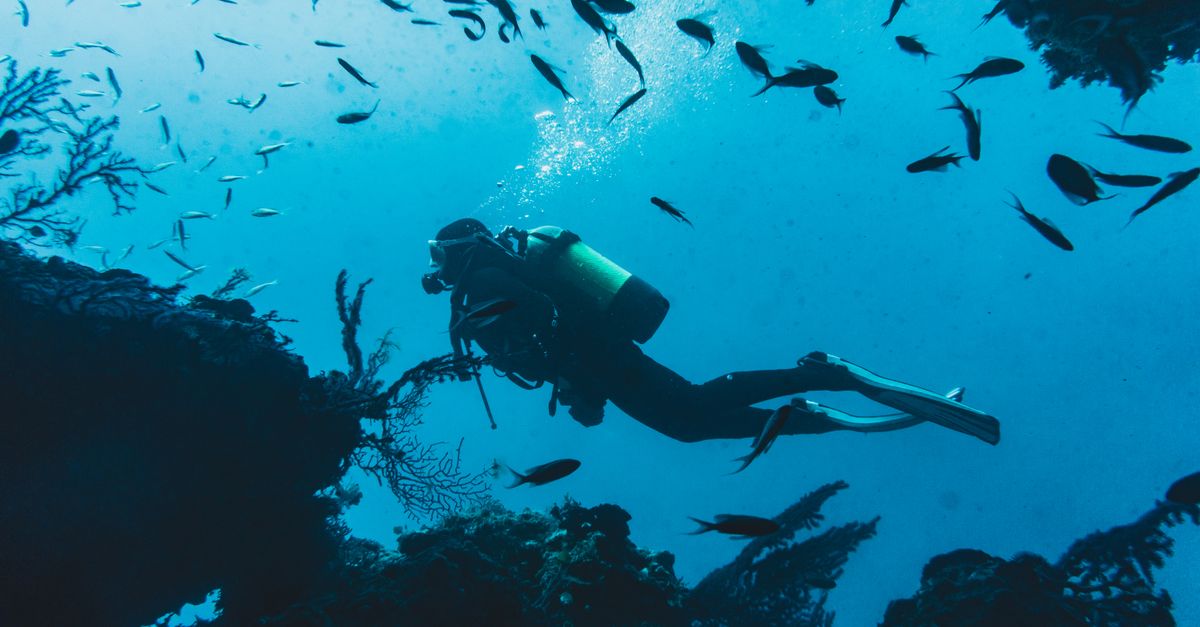
The basic difference
Snorkeling (mask and snorkel) means floating at the surface and breathing through a snorkel while watching the seabed, head in the water. You can occasionally dip down in a short breath-hold, but the main action happens up top.
Scuba diving lets you move underwater for a long time thanks to a compressed-air tank and a regulator, with a buoyancy control device to manage buoyancy. One stays at the surface, the other descends and remains there: that's the essential distinction, and it changes everything in terms of gear, training, sensations and the wildlife you see.
Detailed comparison
| Criterion | Snorkeling | Scuba diving |
|---|---|---|
| Where | At the surface | At depth |
| Breathing | Snorkel (open air) | Tank + regulator |
| Gear | Mask, snorkel, fins | Tank, regulator, BCD, wetsuit, weights |
| Training | None required | Discovery dive then certification |
| Supervision | Independent (with a buddy) | Club / instructor |
| Time underwater | A few seconds on a breath-hold | 30 to 60 min depending on air and depth |
| Medical certificate | No | Usually required |
| Start-up cost | Low | Higher |
Two complementary activities: many people start with snorkeling before moving on to scuba diving.
Sensations and what you see
In snorkeling, you enjoy the light, the vivid colours of the shallows and the coastal wildlife: wrasse, sea bream, octopus, seagrass. It's ideal for gliding over a wide area effortlessly and observing life on the rocks near the surface, as a family and with no constraints.
In scuba diving, you reach another world: wrecks, deep drop-offs, caves, sea fans, groupers and species that never come up to the surface. You can stay still facing the underwater life, in a particular silence punctuated by your own breathing. Depth opens up landscapes inaccessible to the snorkel, at the cost of training and technical management.
How to start snorkeling
It's the ideal entry into the underwater world, with no barrier. Get yourself a watertight mask, a snorkel and fins in your size, choose a calm, clear cove, apply anti-fog to your mask, breathe slowly and always set off with a buddy. A signalling buoy and a UV-protection rash guard round out the kit.
No certification is needed: a few minutes are enough to find your bearings. Start where you can stand, with short outings, and increase the distance as you feel more comfortable. Rocky coasts and seagrass beds offer the most to see; in the morning, in calm seas, you'll enjoy the best visibility.
How to start scuba diving
Diving is learned under supervision, never self-taught. You start with a discovery dive: a first immersion at shallow depth (often 3 to 6 m) with an instructor who handles everything, with no technical prerequisites. It's the best way to find out whether you enjoy the activity.
If the experience appeals, you take a certification within a club or dive centre: FFESSM level 1, PADI/SSI Open Water Diver or equivalent, with theory, exercises in a protected setting and supervised dives. A medical certificate of no contraindication is usually required. These qualifications, internationally recognised, then let you dive at centres all over the world.
Budget, age and health
On budget, snorkeling only requires a mask, a snorkel and fins to get started, often reusable for years. Diving involves a paid discovery dive, a certifying course and then supervised outings or equipment hire: the initial and recurring investment is far higher.
On age and health, snorkeling suits almost everyone, children included, as soon as you're comfortable in the water. Diving sets minimum ages depending on the courses and requires medical fitness, because pressure and breathing compressed air put demands on the body (ears, lungs, heart). In case of medical doubt, a specialist opinion is essential before diving.
Which one to choose?
For an immediate, inexpensive and commitment-free discovery, start with snorkeling: ideal as a family, to scout out the beautiful shallows reachable from the shore and get used to the mask and to breathing in the water. It's also excellent preparation before a first discovery dive.
If you want to stay underwater for a long time, explore deeper, see wrecks and different wildlife, scuba diving opens up another universe, in exchange for training and budget. The two complement each other very well: you can alternate depending on your mood, the time available and the location. For scouting spots, BeachFinder helps find sites with good visibility for both.